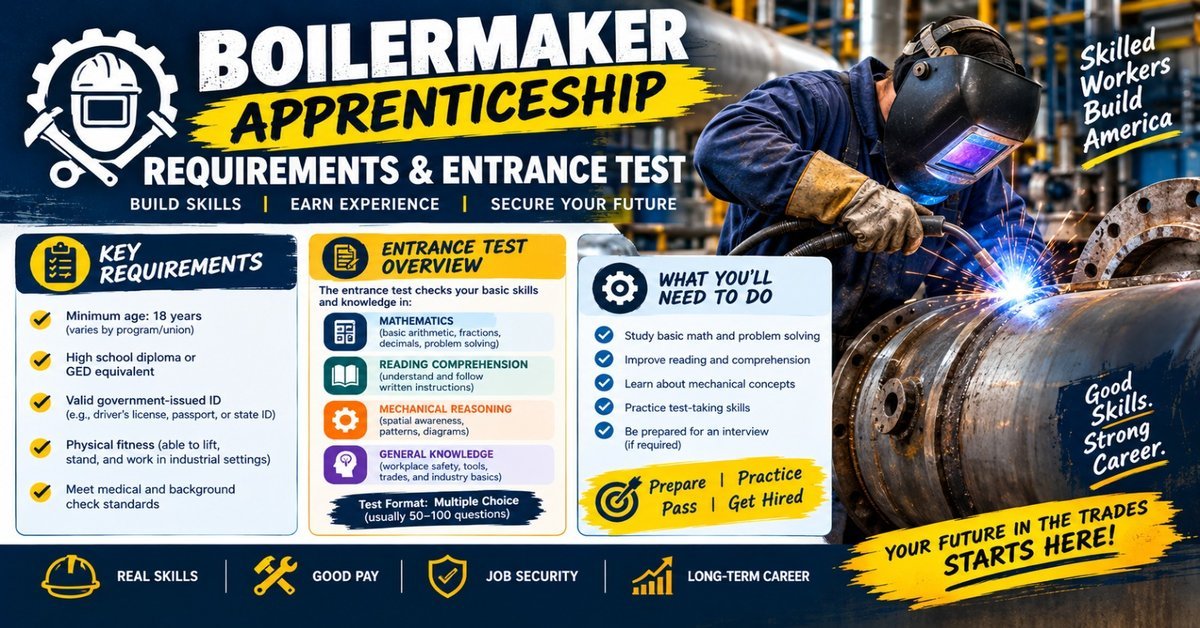
To prepare for an operating engineers apprenticeship test, review basic maths, reading comprehension and mechanical reasoning, then confirm with your local what its process includes. There is no single national test: each local joint apprenticeship committee sets its own application, testing, interview and drug screening, so the format varies by region. The International Union of Operating Engineers is the starting point for finding your local.
What the Apprenticeship Is
Operating engineers run and maintain heavy equipment such as bulldozers, excavators, cranes, graders and loaders. A union apprenticeship combines paid on-the-job training with classroom instruction, usually run by a local with its employers.
Two Real Locals Compared
| Item | Local 49 (Universal Equipment Operator) | Local 150 (Heavy Equipment Operator) |
|---|---|---|
| Age | Minimum 18 | At least 18 |
| Education | High school diploma, GED or equivalent | High school diploma or GED, with transcripts |
| Licence | Valid driver's licence | Valid licence matching the application address |
| Work authorisation | Legally authorised to work in the US | Resident of the local's jurisdiction |
| Selection | Entrance exam on basic reading, math and measurement | Week-One evaluation with classroom and hands-on exercises and an oral interview; applicants ranked by score |
| Other | Fit for work in the craft, with or without reasonable accommodation | Drug testing; a $25 application fee per programme by money order |
| Length | At least 6,000 hours (less any experience), 432 classroom hours | 6,000 or more hours of on-the-job learning |
Sources: Local 49 and the Local 150 FAQ. Local 49 says applicants who fail may re-test in seven days, with a six-month wait after two failed attempts. The Local 150 FAQ mentions an aptitude test appointment for the "Operators Program" and also says there are no entrance exams, so call to confirm which applies. Fees, deadlines and rules can change.
What an Entrance Test Can Cover
- Maths and measurement: arithmetic, fractions, decimals, percentages, ratios, area and volume. Sample (original): a pit 20 ft long, 10 ft wide and 5 ft deep holds 20 × 10 × 5 = 1,000 cubic feet. Excavation is often quoted in cubic yards, so divide by 27: about 37 cubic yards.
- Reading comprehension: short passages on safety, procedures or equipment. Read the question first.
- Mechanical reasoning: levers, pulleys, gears and hydraulics. Sample (original): if a small piston pushes fluid that moves a larger piston, the larger piston delivers more force but moves a shorter distance (see mechanical reasoning explained).
- Spatial reasoning and following instructions: rotated shapes, how parts fit, and multi-step directions.
After the Test
Many programmes rank applicants on a mix of test results, interview scores and sometimes experience, and selection also depends on the number of openings. Expect interview questions about reliability, safety attitude, teamwork and why you want to be an operator, and bring specific examples from jobs, school or volunteering. Heavy equipment work is safety-sensitive, so confirm the drug-testing policy before you apply.
How to Prepare
- Find your local and ask about the format, application dates and documents.
- Review middle- and early high-school maths: fractions, percentages, area, volume and unit conversions (maths basics).
- Practise reading short technical passages.
- Study simple machines and hydraulics.
- Consider an OSHA 10-hour card to show safety awareness.
- Gain relevant exposure: farm, landscaping, shop or site work builds skills and interview material.
- Prepare your documents: ID, diploma or GED, licence and work history.
- Practise under test conditions once you know the real format.
Never pay anyone for a guaranteed apprenticeship place; apply through your local and verify any fee with it directly. See our retake guide too.
Frequently Asked Questions
Is there a national operating engineers apprenticeship test?
No. Each local or training programme sets its own process.
What score do I need to pass?
Standards differ by programme. Ask the local how selection works; Local 150 ranks applicants by score.
Do I need experience operating heavy equipment?
Usually not. Apprenticeships train beginners, though experience can help at interview. Check your local.
How long is the apprenticeship?
Local 49 states a minimum of 6,000 hours with 432 classroom hours; Local 150 says 6,000 or more hours.
Can I retake the Local 49 exam?
Its page says you may re-test in seven days, with a six-month wait after two failed attempts.
Is there an application fee?
Local 150 lists $25 per programme by money order; fees differ by local.
Is a drug test required?
Local 150 states applicants will be drug tested. Confirm with your local.
How much do apprentices earn?
Apprentices earn a percentage of the journeyman wage that rises with progress; ask your local for its scale.
People Also Search For
Operating engineers apprenticeship test
Set by the local.
IUOE apprenticeship requirements
Age, diploma, licence.
Heavy equipment operator apprenticeship
6,000 hours.
Local 49 entrance exam
Reading, math, measurement.
Local 150 apprenticeship
Week-One evaluation.
Operating engineers aptitude test
Not in every local.
Equipment operator apprentice
Paid training.
IUOE test preparation
Maths, reading, mechanics.
More Job Guides
Related guides:
- Apprenticeship Test Math: The Basics You Need to Know — maths revision
- Mechanical Reasoning Questions Explained — levers, gears, hydraulics
- Can You Retake the Apprenticeship Aptitude Test? — retake rules
- Laborers Union Entrance Exam: What Gets Asked — LiUNA
This article is a general guide and not legal, financial or immigration advice. Reviewed on 16 October 2026 against official sources. Rules, fees and requirements change, so follow the official instructions for your own case.