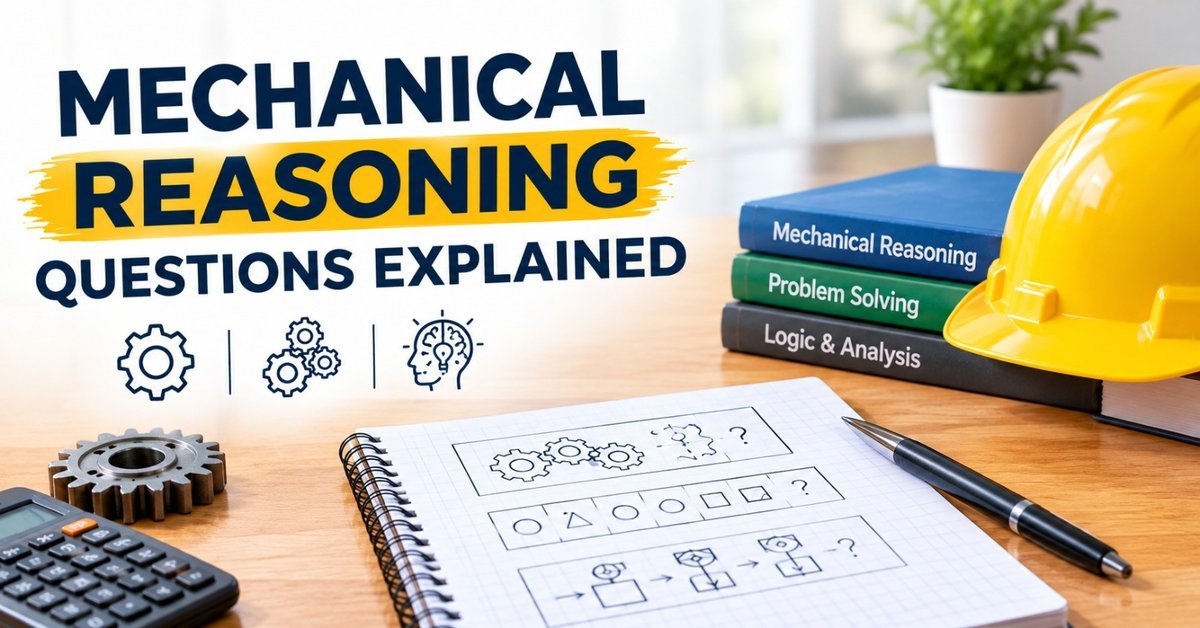
Mechanical reasoning questions test whether you understand how basic physical systems work, such as levers, pulleys, gears and hydraulics, usually through a diagram and a short question. They appear on trade apprenticeship, technician and some pre-employment tests because they show how well someone is likely to understand tools and machinery. Formats vary: for example the NEIEP elevator test has a 35-question mechanical aptitude section that points to levers, pulleys, gears, hydraulics and fulcrums, and Pipefitters Local 597 lists a Bennett Mechanical Aptitude section. Confirm your own test's format with your programme.
Why Tests Include It
Employers in construction, manufacturing and the skilled trades use these questions because they measure practical, spatial and physical-logic thinking, which is hard to cram. A candidate who reasons well about levers and gears tends to learn equipment faster, even without hands-on experience.
Seven Core Concepts
1. Levers
A lever is a rigid bar pivoting on a fixed point, the fulcrum. The farther from the fulcrum you push, the less force you need. Example: two people lift a rock with a crowbar; the one holding it farther from the fulcrum uses less force.
2. Pulleys
A fixed pulley only changes the direction of the force. A movable pulley reduces the force needed but needs more rope pulled. Example: adding a second, movable pulley roughly halves the force while you pull twice the length of rope.
3. Gears
Meshed gears turn in opposite directions. A small gear driving a large gear gives more torque and less speed; the reverse gives more speed and less torque. Example: gear A has 10 teeth and gear B has 30. When A makes 3 turns, B makes 1 turn, in the opposite direction.
4. Hydraulics
Fluid cannot be compressed, so pressure is passed on through it. A small force on a small piston gives a larger force on a large piston, but the large piston moves a shorter distance. Example: the large piston gives more force and less movement.
5. Inclined Planes and Wedges
A longer, gentler ramp needs less force than a short, steep one to raise the same load by the same height. Example: the long, gentle ramp needs less force because the distance is greater.
6. Centre of Gravity and Balance
Low, wide objects are more stable; tall, narrow or top-heavy ones tip more easily. Example: a box with heavy items on top is less stable than the same box loaded the other way.
7. Simple Circuits and Flow
In a series circuit, one open switch breaks the whole circuit; in a parallel circuit, the other paths still work. Example: three bulbs in series and one burns out: all three go dark.
All examples are original practice problems, not real exam questions.
How to Approach a Question
- Study the diagram before you read the answer choices.
- Identify what is fixed and what moves, such as the fulcrum or the direction a gear turns.
- Think in trade-offs: systems usually trade force for distance, or speed for torque.
- Eliminate impossible answers first.
- Use real-world intuition: a wrench, a wheelbarrow, a bicycle.
- Watch directions and units, especially on gear and balance questions.
How to Practise
- Learn the seven concepts before you attempt practice sets.
- Draw the diagrams and label the forces.
- Do timed sets once you know your test's real time limit.
- Review every wrong answer and name the concept you missed.
- Relate each concept to a real tool you have used.
- Retest weak areas a few days later.
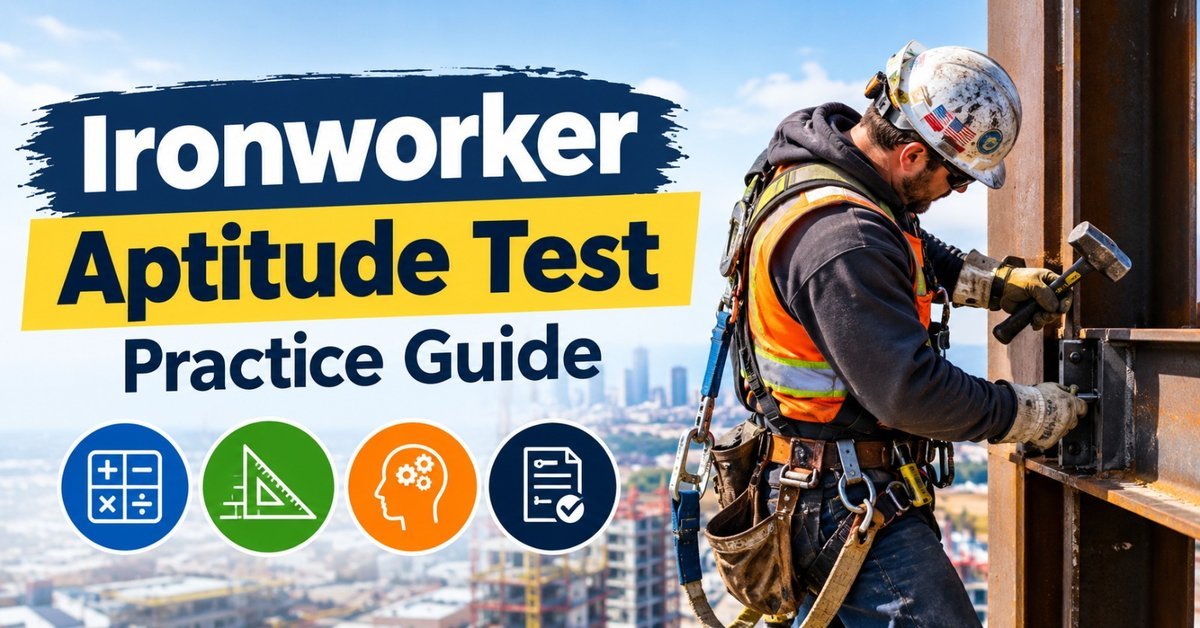
The maths involved is usually simple ratios, such as gear-tooth counts or lever-arm lengths; the main challenge is visualising how the system behaves. See apprenticeship test maths basics, retake rules and the ironworker test guide.
Frequently Asked Questions
Are mechanical reasoning questions hard to prepare for?
They are learnable. Most rely on a small set of repeating concepts.
Do I need an engineering background?
No. These tests are designed for people without formal engineering training.
What jobs use mechanical reasoning tests?
Trade apprenticeship exams, maintenance technician tests and some pre-employment assessments; the topics vary by employer.
Can I improve quickly if I am weak here?
Yes, with focused practice. Drawing examples by hand helps more than only reading.
Is there math involved?
Some simple ratios, such as gear-tooth counts or lever-arm lengths. The math is usually basic.
Which direction does the second of two meshed gears turn?
The opposite direction to the first.
Does a longer lever need more or less force?
Less force, because a longer distance from the fulcrum gives more leverage.
Is the format the same everywhere?
No. Confirm your programme's test format before relying on a single practice guide.
People Also Search For
Mechanical reasoning questions
Seven repeating concepts.
Mechanical aptitude test
Diagram-based.
Levers pulleys gears
Trade force for distance.
Hydraulics test questions
More force, less movement.
Mechanical comprehension practice
Draw the diagram.
Apprenticeship mechanical test
Check the format.
Bennett mechanical aptitude
Listed by Local 597.
Simple machines questions
Think in trade-offs.
More Job Guides
Related guides:
- Apprenticeship Test Math: The Basics You Need to Know — maths revision
- Ironworker Aptitude Test: Format, Math and Practice — ironwork entry
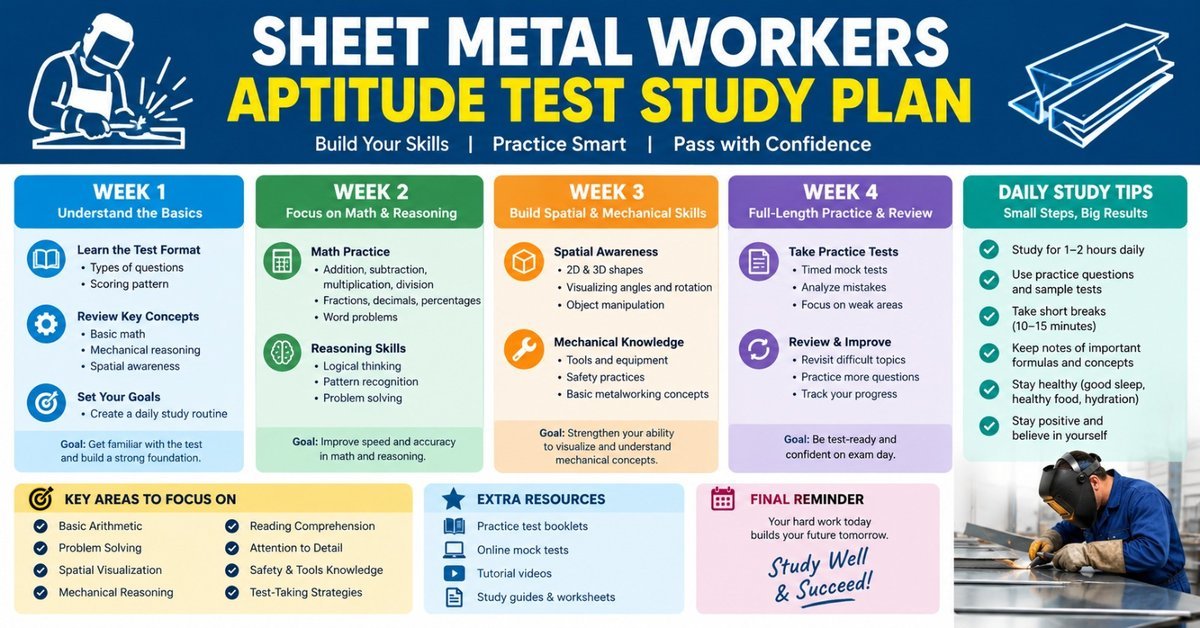
- Sheet Metal Aptitude Test: Sections, Tips, Study Plan — sheet metal entry
- Can You Retake the Apprenticeship Aptitude Test? — retake rules
This article is a general guide and not legal, financial or immigration advice. Reviewed on 16 October 2026 against official sources. Rules, fees and requirements change, so follow the official instructions for your own case.