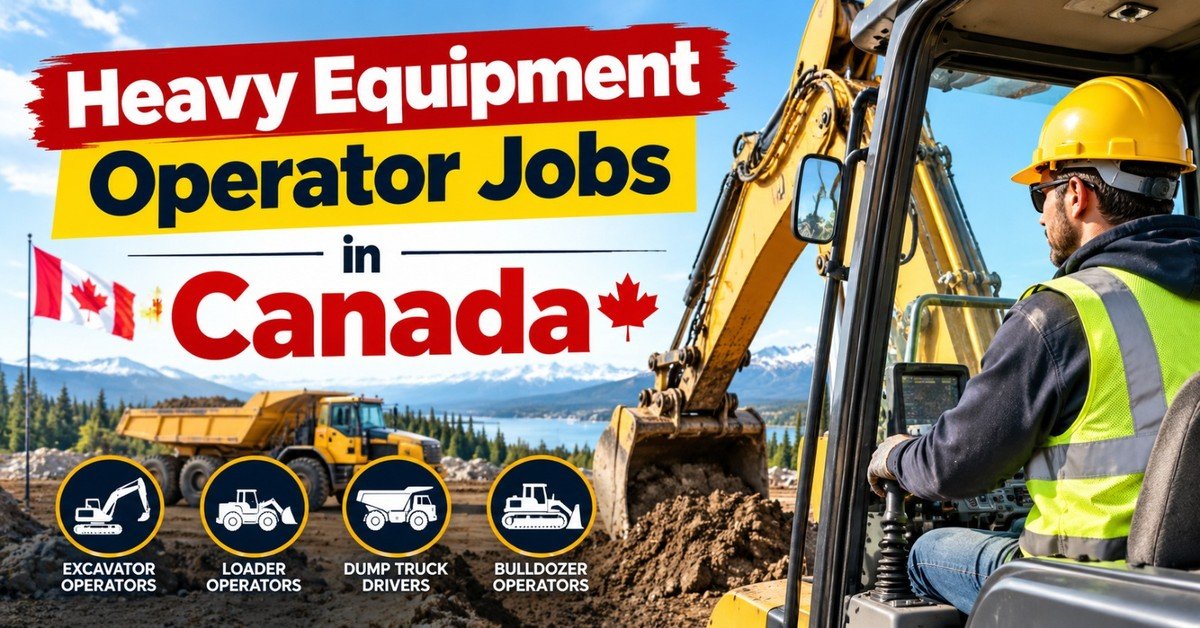
Heavy equipment operators run the excavators, dozers, loaders, backhoes and graders that build Canada's roads, subdivisions, pipelines and mines. It is hands-on, well-paid work that can be learned through a short course and on-site experience, with apprenticeships for those who want a certificate. Before you train or apply, it helps to know what operators really earn in each province, where the outlook is weakest, which tickets are compulsory, and what the job does for immigration.
What the Official Outlook Says
Guides say skilled operators remain in steady demand from coast to coast. Canada classifies the job as NOC 73400, heavy equipment operators, a TEER 3 occupation, and the official outlook is more uneven:
| Job Bank outlook 2025-2027 | Provinces and territories |
|---|---|
| Good | Saskatchewan, Prince Edward Island, Nunavut |
| Moderate | Ontario, Nova Scotia, New Brunswick, Newfoundland and Labrador, Yukon |
| Limited | Alberta, British Columbia, Quebec, Manitoba, Northwest Territories |
Nationally, the 2024 to 2033 projection is Balance: labour demand and supply are expected to be broadly in line. Guides single out Alberta and British Columbia for remote resource work, but both are rated Limited for 2025 to 2027. Those provinces still pay well, as the table below shows, but new operators compete for fewer openings.
What a Heavy Equipment Operator Does
- Operating excavators, dozers, loaders, backhoes and graders
- Digging, grading and levelling to site plans and grade stakes
- Loading and moving gravel, soil, rock and debris
- Pre-shift inspections, greasing and basic maintenance
- Working with ground crews and spotters around workers and utilities
- Reporting mechanical problems before they become breakdowns
Guides include cranes in the list of machines. Crane operators are a separate occupation (NOC 72500) with their own compulsory certification in most provinces, covered below.
Heavy Equipment Operator Salary by Province
Guides quote CAD 45,000 to 55,000 for entry-level operators, 55,000 to 75,000 for experienced operators and 75,000 to 100,000 or more for specialized operators. Job Bank's wages for NOC 73400, updated in November 2025, are close to that spread. Annual figures below assume 2,080 hours, a full year of 40-hour weeks:
| Area | Low | Median | High |
|---|---|---|---|
| Canada | $24.00 ($49,920) | $32.50 ($67,600) | $45.00 ($93,600) |
| British Columbia | $27.00 ($56,160) | $35.75 ($74,360) | $46.00 ($95,680) |
| Quebec | $24.00 ($49,920) | $36.00 ($74,880) | $43.40 ($90,272) |
| Alberta | $26.00 ($54,080) | $34.30 ($71,344) | $45.00 ($93,600) |
| Ontario | $23.63 ($49,150) | $32.00 ($66,560) | $47.70 ($99,216) |
| Nova Scotia | $18.00 ($37,440) | $25.00 ($52,000) | $35.50 ($73,840) |
| Northwest Territories | $26.80 ($55,744) | $43.73 ($90,958) | $64.01 ($133,141) |
- Quebec, not Alberta, has the highest provincial median, at $36.00 an hour, with British Columbia close behind. The Northwest Territories pay the most overall.
- Atlantic Canada pays much less. Medians in Nova Scotia and New Brunswick are $25.00 an hour.
- Annual figures assume year-round work. Road and civil construction slows in winter in most provinces, so a seasonal operator can earn well below the annual equivalent. Camp and overtime hours can push it above.
Training, Red Seal and Apprenticeships
Most operators start with a private or college operator course lasting weeks to months, then build seat time on site. Guides say some provinces offer apprenticeships. The national standard is the Red Seal program, which has three heavy equipment operator trades:
- Heavy Equipment Operator (Dozer)
- Heavy Equipment Operator (Excavator)
- Heavy Equipment Operator (Tractor-Loader-Backhoe)
The Dozer trade is designated in New Brunswick, Newfoundland and Labrador, Nova Scotia, Nunavut, Ontario, Prince Edward Island and Quebec. It is not designated in Alberta or British Columbia, where employers rely on experience, operator courses and in-house assessments instead. In Quebec, construction industry work is regulated by the Commission de la construction du Québec, which issues competency certificates for construction trades.
Crane Tickets Are Compulsory
Guides give Ontario and Alberta as examples of provinces with a crane operator ticket. The requirement is wider: mobile crane operator certification, for specified types of cranes, is compulsory in Nova Scotia, New Brunswick, Quebec, Ontario, Manitoba, Alberta and British Columbia.
- Ontario. Hoisting Engineer — Mobile Crane Operator 1 and Mobile Crane Operator 2 are trades with apprenticeship programs administered by Skilled Trades Ontario. Mobile Crane Operator 1 covers lattice and telescopic boom cranes lifting more than 16,000 pounds.
- Alberta. You must hold a recognized certificate or be a registered apprentice to operate a boom truck, tower crane or mobile crane, with mobile crane certification applying from 15 tons of lifting capacity.
Safety Training
- Working at heights in Ontario. Construction workers who use fall protection must complete a working at heights program approved by the Chief Prevention Officer and delivered by an approved provider. It is valid for three years, and the province warns about fraudulent providers.
- WHMIS. Workers who handle hazardous products must receive WHMIS education and training from their employer.
- Site orientation and ground disturbance. Pipeline and oil and gas sites commonly ask for ground disturbance training before an operator digs.
Immigration: What the Job Does and Does Not Do
- Not in the Express Entry trades category. IRCC's trade occupations list, last modified on 22 June 2026, does not include heavy equipment operators (73400) or crane operators (72500). It does include heavy-duty equipment mechanics (72401).
- Federal Skilled Trades Program. The occupation falls in NOC major group 73, which the program covers, but you still need a qualifying job offer or a provincial certificate of qualification, plus the language minimums.
- LMIA jobs. Employers can hire through the Temporary Foreign Worker Program, and the wage offered decides which stream applies. See our visa sponsorship guide for how the streams work.
Where to Find Heavy Equipment Operator Jobs
- Job boards. Indeed Canada and Job Bank list civil, municipal, mining and forestry postings.
- Union hiring halls. International Union of Operating Engineers locals dispatch members to union contractors and run training.
- Contractors and mining companies. Large civil and resource companies post directly, often before the spring season.
- Municipalities. Cities and counties hire operators for road maintenance and snow clearing, which evens out the season.
Tips for Landing a Heavy Equipment Operator Job
- List machines and hours. Name each machine, the size class and roughly how many hours you have on it.
- Carry your tickets. Working at heights in Ontario, WHMIS and any ground disturbance or crane certificates.
- Apply before spring. Civil contractors hire for the season in late winter and early spring.
- Expect a seat test. Many employers assess you on the machine before hiring.
- Consider snow clearing. Municipal winter work fills the gap in the construction season.
Career Progression
Operators move into lead operator, foreman and site supervisor roles, equipment training and safety, or fleet management. Some add a crane certificate through a compulsory crane apprenticeship, and others move into heavy-duty equipment mechanics, a separate Red Seal trade that is in the Express Entry trades category.
Frequently Asked Questions
How much do heavy equipment operators make in Canada?
Job Bank reports a national median of $32.50 an hour for NOC 73400, about $67,600 a year for full-year 40-hour weeks, with provincial medians from $25.00 in Nova Scotia to $36.00 in Quebec.
Which province pays heavy equipment operators the most?
Quebec has the highest provincial median at $36.00 an hour, followed by British Columbia at $35.75. The Northwest Territories median is $43.73.
Is there a Red Seal for heavy equipment operators?
Yes. Heavy Equipment Operator (Dozer), (Excavator) and (Tractor-Loader-Backhoe) are Red Seal trades, though not every province designates them.
Do I need a ticket to operate a crane in Canada?
For specified types of mobile cranes, certification is compulsory in Nova Scotia, New Brunswick, Quebec, Ontario, Manitoba, Alberta and British Columbia.
Is working at heights training required in Ontario?
Yes, for construction workers who use fall protection. The training must be approved by the Chief Prevention Officer and is valid for three years.
Is the job outlook good in Alberta?
Job Bank rates the 2025-2027 outlook for heavy equipment operators as Limited in Alberta and British Columbia, and Good in Saskatchewan.
Are heavy equipment operators in the Express Entry trades category?
No. The trade occupations list does not include NOC 73400, although heavy-duty equipment mechanics are included.
How long does heavy equipment operator training take?
Operator courses usually run from a few weeks to several months; a Red Seal apprenticeship takes longer and combines on-site hours with technical training.
People Also Search For
Excavator operator jobs Canada
The most common operator posting, with a Red Seal trade of its own.
Heavy equipment operator salary Alberta
A Job Bank median of $34.30 an hour, with a Limited outlook for 2025-2027.
Heavy equipment operator jobs BC
A $35.75 median, but a Limited outlook.
Red Seal excavator
One of three Red Seal heavy equipment operator trades.
Mobile crane operator certification
Compulsory for specified cranes in seven provinces.
Working at heights Ontario
Required with fall protection on construction projects, valid three years.
Operating engineers union Canada
IUOE locals run hiring halls and training for operators.
Heavy equipment operator NOC code
NOC 73400, a TEER 3 occupation.
More Job Guides
Comparing trades and driving jobs? These cover them:
- Welder Jobs in Canada — a Red Seal trade on the same sites, and where certification is compulsory.
- Visa Sponsorship Jobs in Canada — how the LMIA streams work for trades employers.
- Bus Driver Jobs in Canada — another licensed machine job with provincial rules.
- Farm Worker Jobs in Canada — seasonal work on another Canadian program.
- Construction Worker Jobs in Australia — site work under Australian awards and the White Card.
- CDL Driver Jobs in USA — heavy vehicle work and licence classes across the border.
- Forklift Operator Jobs in USA — warehouse machines in the USA, where OSHA sets the training rule.
- Jobs in Canada for Foreign Workers — what changed in 2026, which sectors hire, and how the LMIA and scams work.
This article is for general informational purposes and is not legal, immigration or careers advice. Wage data, outlooks, trade certification rules, safety training requirements and Express Entry categories change and differ by province. Confirm the current position with Job Bank, the Red Seal program, your provincial apprenticeship authority and IRCC before training, applying or accepting an offer.