Commercial driving is one of the few jobs in the United States that still pays a middle income without a four-year degree, and it is genuinely open to newcomers. It is also the job most consistently oversold, because the people who benefit from a steady stream of applicants are often the people selling the training. Here is what the federal record actually says.
The "Driver Shortage" Is Disputed by the Labor Department Itself
Almost every CDL guide opens the same way: a well-documented driver shortage, strong job security, competitive pay. It is worth knowing that the US Bureau of Labor Statistics published research reaching the opposite conclusion.
In the BLS Monthly Labor Review, economists Stephen Burks and Kristen Monaco examined the long-distance truckload segment and found that while turnover has been high and persistent for decades, "the overall picture is consistent with a market in which labor supply responds to increasing labor demand over time, and a deeper look does not find evidence of a secular shortage."
Their description of the problem is different from the usual one: long-haul truckload is a high-turnover secondary labour market, and high turnover is a sign that the jobs are unattractive to many potential workers — not that the workers do not exist. The American Trucking Associations disputes this and continues to publish shortage figures.
You do not have to pick a side to use this. The practical point is that "there is a shortage, so you will be in demand" is a contested claim, not a settled fact, and it is usually made by someone who wants you to enrol. Judge an offer on its pay, its route and its home time.
The projection supports caution. BLS expects employment of heavy and tractor-trailer truck drivers to grow 4 per cent from 2025 to 2035 — about as fast as the average for all occupations, on a base of 2,221,200 jobs. That is a stable, large occupation. It is not an exceptional one.
What CDL Drivers Actually Earn
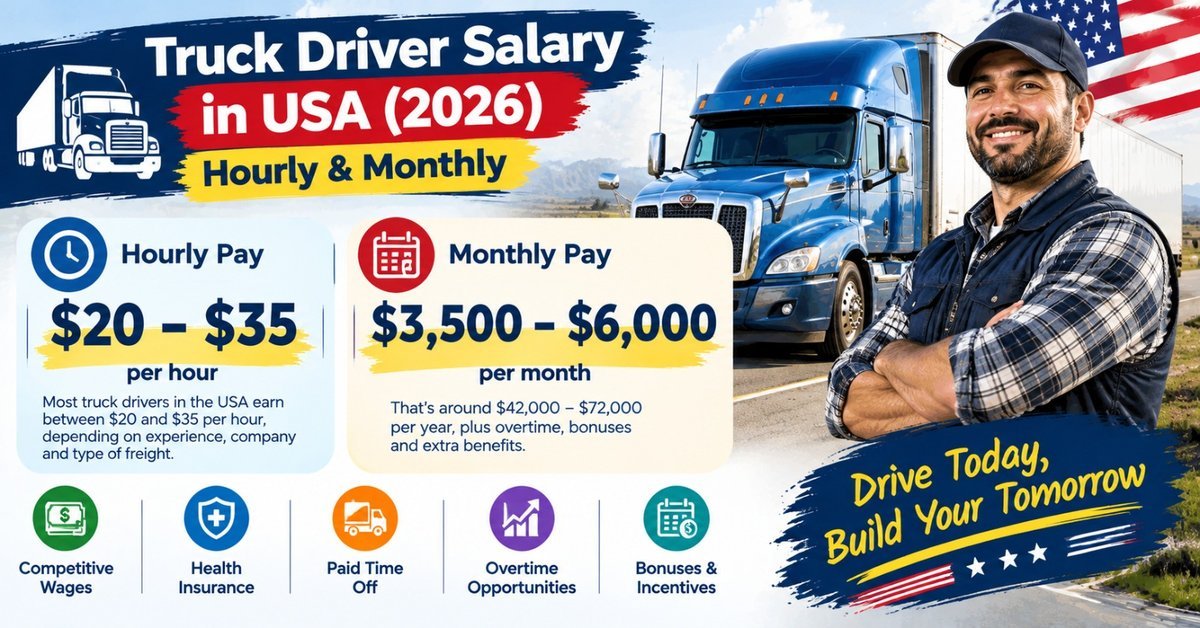
The draft figures circulating for this job are $50,000 to $75,000 average, and $80,000 to $100,000 or more for specialised work. Here is the federal wage data for heavy and tractor-trailer truck drivers, May 2025:
- Median annual wage: $58,640. Half of all drivers earned less than this
- Lowest 10 per cent: less than $40,140
- Highest 10 per cent: more than $79,380
Read the last line again, because it reframes the whole pitch. The $80,000 that guides present as a normal outcome for a specialised driver is approximately where the top ten per cent begins. It is achievable. It is not typical, and it usually costs you nights at home.
The $40,140 floor matters just as much, and it is the number missing from every recruitment advertisement. A new driver on a training contract, running local or starting with a carrier that pays low mileage rates, can land nearer that floor than the median in year one.
Cents Per Mile Is Not an Hourly Wage
Most over-the-road and regional jobs pay by the mile. That single fact explains most of the gap between advertised pay and real pay, because the clock keeps running when the wheels are not.
Time spent waiting at a shipper to be loaded, sitting in traffic, waiting for a repair, or shut down by weather generally earns nothing under a pure mileage scheme. Two drivers paid the same cents per mile can end the week hundreds of dollars apart based on how their loads were planned.
So when you compare offers, ask four questions: What are the cents per mile? How many miles a week do your drivers actually run? Is detention pay available, after how many hours, and how much? Is there stop pay, layover pay or breakdown pay? A slightly lower rate with real detention pay and well-planned freight beats a headline rate with neither.
Training Is Now Federally Mandatory, Not Optional
Guides still list "completion of an accredited CDL training program" among the things employers like to see. Since 7 February 2022 it has not been a preference. The FMCSA Entry-Level Driver Training (ELDT) rule requires it.
ELDT applies when you:
- Obtain a Class A or Class B CDL for the first time
- Upgrade an existing Class B CDL to a Class A
- Obtain a Hazmat (H), Passenger (P) or School Bus (S) endorsement for the first time
You must complete theory and behind-the-wheel instruction before taking the CDL skills test, and it only counts if the provider appears on the FMCSA Training Provider Registry. A school that is not on the registry cannot give you a qualifying certificate, whatever its advertising says. Check the registry before you pay anyone.
The rule is not retroactive: if you held the CDL or the endorsement before 7 February 2022, you do not need to go back and train for it.
On paid training. Many carriers do pay for your CDL, and that is a real route in for people without savings. It normally comes with a contract committing you to the company for a period, with the cost repayable if you leave early. Read what you owe, and when, before signing — it is the difference between a free licence and a debt to your employer.
You Must Be 21 to Drive Across State Lines
The draft never mentions age, which is a significant omission, because it decides what work is open to you.
- 21 is the federal minimum for interstate driving — crossing state lines — and also for hazardous materials and passenger-carrying work
- 18 is the minimum for a CDL in nearly every state, but an 18-to-20-year-old is limited to intrastate work, inside their own state
- The FMCSA Safe Driver Apprenticeship Pilot allows qualified drivers aged 18 to 20 who hold intrastate CDLs to run interstate under the programme's conditions
If you are 19, most long-haul advertisements are not open to you yet, whatever the recruiter implies. Plan for local and intrastate work first.
The Hours That Govern Your Day
Hours of service are the shape of the job, and a guide that mentions electronic logging devices without the limits has told you nothing. For property-carrying drivers:
| Rule | The limit |
|---|---|
| Driving limit | 11 hours, after 10 consecutive hours off duty |
| Duty window | You may not drive beyond the 14th consecutive hour after coming on duty |
| Rest break | 30 minutes required after 8 cumulative hours of driving |
| Weekly limit | 60 hours in 7 consecutive days, or 70 hours in 8 |
| Restart | 34 or more consecutive hours off duty resets the weekly clock |
Note what the 14-hour window means in practice: non-driving time counts against it. Three hours waiting to be loaded consumes three hours of your window, and no amount of remaining driving hours brings them back. That is why detention pay is worth arguing about.
Endorsements, and What Hazmat Really Involves
Endorsements are where the higher rates are, and the draft's description of hazmat as "specialized certification" understates it considerably.
- Hazmat (H). Requires a TSA security threat assessment under 49 CFR Part 1572, including a fingerprint-based FBI criminal history records check and identity verification. Certain convictions are permanently disqualifying and others disqualify for a period. It is a background investigation, not a course
- Tanker (N). Liquid and gas loads, where the cargo moves as you brake
- Doubles/Triples (T). Multiple trailers
- Passenger (P) and School Bus (S). Both now require ELDT for a first endorsement
Also: employers must query the FMCSA Drug and Alcohol Clearinghouse before hiring you and annually after. A recorded violation puts a driver in prohibited status until the return-to-duty process is complete, and it follows the driver between employers. This is the single fastest way to lose a commercial driving career.
Owner-Operator Income Is Revenue, Not Pay
Career-path lists usually put "owner-operator" above company driver, as the step where the money improves. Sometimes it does. But the figures quoted for owner-operators are gross revenue, and everything comes out of it.
The truck payment or lease, fuel, insurance, maintenance, tyres, permits, tolls, parking, and self-employment tax at 15.3 per cent of net earnings all come off before you are paid. A driver grossing $200,000 can take home less than a company driver on the median wage if the numbers are wrong, and lease-purchase arrangements in particular deserve careful reading.
Treat it as starting a business that happens to involve driving, because that is what it is.
The Types of CDL Work
- Over-the-road (OTR). Multi-state, highest advertised mileage pay, weeks away from home
- Regional. One area of the country, usually home at weekends
- Local / delivery. Home daily, frequently hourly rather than by the mile, more loading and unloading
- Tanker. Liquids and gases, requiring the N endorsement
- Hazmat. Higher rates, TSA clearance, and more responsibility
- Flatbed. Oversized and open loads, with securement and tarping work in all weather
- Bus and transit. A CDL with a passenger endorsement, usually local hours and a public-sector pension
Coming from Outside the United States
The posters advertising this work sometimes promise visa sponsorship and accommodation. Be careful. A CDL is issued by the state where you are domiciled, and there is no US work visa category for commercial driving as such. Sponsorship for drivers happens through general employment-based routes rather than a driver visa, and it is slow and employer-specific. Our truck driver jobs in USA with visa sponsorship guide sets out the EB-3 and H-2B positions honestly, including what those routes cannot do.
Frequently Asked Questions
How much do CDL drivers earn in the USA?
The BLS median annual wage for heavy and tractor-trailer truck drivers was $58,640 in May 2025. The lowest 10 per cent earned less than $40,140 and the highest 10 per cent more than $79,380.
Is there really a truck driver shortage in the United States?
It is disputed. Research published in the BLS Monthly Labor Review by Stephen Burks and Kristen Monaco found no evidence of a secular shortage, describing long-haul truckload instead as a high-turnover segment. The American Trucking Associations disagrees and continues to publish shortage estimates.
Do I need to attend a CDL school?
Yes. Since 7 February 2022 the FMCSA Entry-Level Driver Training rule requires theory and behind-the-wheel instruction before the skills test, from a provider listed on the Training Provider Registry, for a first Class A or B CDL, a Class B to Class A upgrade, and first-time H, P or S endorsements.
How old do you have to be to drive a truck across state lines?
21. Drivers aged 18 to 20 can hold a CDL in nearly every state but are restricted to intrastate work, unless they are in the FMCSA Safe Driver Apprenticeship Pilot. Hazmat and passenger work also require 21.
How many hours can a CDL driver drive in a day?
Up to 11 hours, after 10 consecutive hours off duty, and never beyond the 14th consecutive hour after coming on duty. A 30-minute break is required after 8 cumulative hours of driving.
What does a hazmat endorsement require?
A TSA security threat assessment under 49 CFR Part 1572, including a fingerprint-based FBI criminal history records check and identity verification, plus ELDT for a first-time endorsement. Some convictions are permanently disqualifying.
Is being an owner-operator more profitable than driving for a company?
Not automatically. Owner-operator figures are gross revenue, and the truck, fuel, insurance, maintenance, permits and self-employment tax of 15.3 per cent come out of it before you are paid.
Is the job outlook for truck drivers strong?
Steady rather than strong. BLS projects 4 per cent growth from 2025 to 2035, about as fast as the average for all occupations, from a base of 2,221,200 jobs.
People Also Search For
CDL training cost
Check the FMCSA Training Provider Registry first. A school that is not listed cannot issue a qualifying ELDT certificate.
Paid CDL training companies
Real, and usually tied to a contract with the cost repayable if you leave early. Read the repayment terms before signing.
Class A vs Class B CDL
Class A covers most tractor-trailer work; Class B covers heavy single vehicles such as box trucks and buses. Upgrading B to A now requires ELDT.
OTR driver salary
The highest advertised mileage rates and the most nights away. Ask about weekly miles and detention pay, not just cents per mile.
Local CDL jobs home daily
Often hourly rather than mileage-based, with more loading work and lower headline pay but a normal week.
Hazmat endorsement requirements
TSA security threat assessment, fingerprinting and an FBI criminal history check, plus ELDT for a first endorsement.
FMCSA Drug and Alcohol Clearinghouse
Employers must query it before hiring and annually. A violation puts you in prohibited status until return-to-duty is complete.
CDL jobs no experience
Genuinely open to newcomers through paid training, but expect first-year pay nearer the $40,140 end than the median.
More Job Guides
Comparing driving work and other routes into American employment? These cover them:
- Truck Driver Jobs in USA with Visa Sponsorship — the EB-3 and H-2B routes, and what they cannot do for a driver.
- Delivery Driver Jobs in USA — van and app-based work on an ordinary licence, and what your own car costs per mile.
- Bus Driver Jobs in Canada — passenger driving with a provincial licence and Job Bank pay figures.
- Unskilled Jobs in USA for Foreigners — where the genuine entry-level visa routes actually are.
- Construction Jobs in USA for Foreigners — manual work and the visa categories that reach it.
- Warehouse Jobs UK Visa Sponsorship — the depot end of the freight chain, in Britain.
- Driver Jobs in Saudi Arabia for Foreigners — driving work on a sponsored Gulf contract instead.
- Taxi Driver Jobs in Australia — passenger driving and the accreditation it needs.
- Forklift Operator Jobs in USA — warehouse work at the other end of the load, and the OSHA training rule.
- How to Become a Long-Haul Truck Driver in USA — the permit, ELDT training, the 14-day rule and what the first year pays.
- How to Get a Transport Job in Germany — the CE licence and code 95 rules, official pay and the driver visa route.
- How to Apply for UPS Package Handler Jobs in the USA — warehouse work where a union contract publishes the wage scale.
- How to Apply for FedEx Delivery Jobs in the USA — and how to tell a real FedEx job from a contractor advert.
This article is for general informational purposes and is not legal, tax or immigration advice. Federal regulations, wage data and state licensing rules change. Confirm the current position with the FMCSA, the Bureau of Labor Statistics, your state licensing agency and the employer's own advertisement before applying.