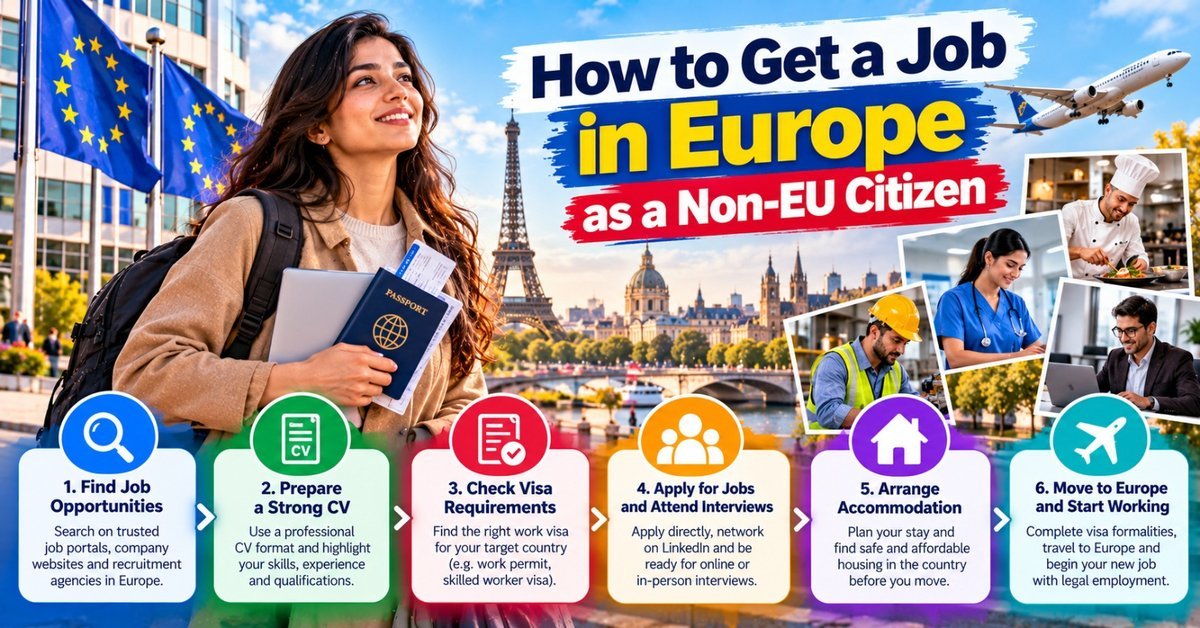
To get a job in Europe as a non-EU citizen, choose a country and an eligible occupation, find an employer willing to hire you, and complete that country's employment and immigration requirements. There is no single Europe work visa that allows employment everywhere: Europe includes EU and non-EU countries, each with its own rules. Check eligibility first and target vacancies that can support your immigration needs.
1. Choose a Country Before a Visa
Shortlist two countries using your occupation, qualifications, language and budget. EU member states make their own immigration decisions under EU and national rules (see the EU immigration page), so an offer in one country does not authorise work in another, and Schengen travel is not permission to work. The EU Immigration Portal is the official starting point.
2. Match Your Profile to a Route
| Route | Main point to investigate |
|---|---|
| EU Blue Card | Qualifications, job offer and national salary threshold |
| Germany Opportunity Card | Eligibility to enter for a job search |
| Ireland employment permits | Occupation eligibility and the correct permit |
| Netherlands highly skilled migrant | Recognised sponsor and salary conditions |
| France salaried employment | Employer work authorisation and visa |
| UK Skilled Worker | Approved sponsor and eligible job |
These are starting points, not a full list or a ranking of the easiest countries.
3. EU Blue Card
The EU Blue Card is for eligible highly qualified non-EU workers in taking part member states. It needs an employment contract or binding offer and compliance with qualification and national salary conditions. A degree alone is not enough, the salary threshold differs between countries, and mobility rights have their own conditions.
4. Germany
Make it in Germany explains looking for a job and work routes. The Opportunity Card is a separate option for eligible people to look for work, with qualification and other eligibility conditions and limits on the work allowed during the search. Budget for living costs, because a job is not guaranteed.
5. Ireland
Ireland has several employment permits, including the Critical Skills Employment Permit and the General Employment Permit. Their occupation, remuneration and other conditions differ, so check which one fits the job.
6. Netherlands and France
For the Dutch highly skilled migrant route the employer must be a recognised sponsor of the IND and salary conditions must be met, so ask whether the company can support your category. France-Visas explains salaried employment and the employer's work authorisation.
7. The UK Is a Separate System
The UK is outside the EU. Its Skilled Worker route needs an eligible job with an approved employer. EU residence permission does not by itself give UK work rights, so ask the employer whether it can sponsor your role.
8. Look for Employers, Not Just Visa Keywords
EURES offers European job search resources, but a listed vacancy does not mean the employer will hire or sponsor a non-EU applicant. Read whether employers need existing work rights, local registration or language ability, put your immigration needs honestly in your application and keep a tracker of employer, reference, country and response. When you are refused, look for the cause: occupation, language, qualification recognition or employers unable to hire internationally.
9. Prepare Your Application
Write a CV focused on relevant experience, equipment and results, and state your location and availability. For regulated professions, non-EU applicants follow the destination's qualification recognition rules (see the European Commission guidance). Professional registration and immigration approval are separate. Typical documents include a passport, an employment contract or offer, qualifications, translations and, for some routes, proof of funds or insurance; use the official checklist for your route.
10. Verify the Offer and Plan the Move
Confirm the employer through contact details you found yourself, and get salary, duties, location and contract terms in writing. Ask who submits each application and who pays each cost. Compare net pay with rent, transport and relocation costs, and do not resign or book expensive travel on an interview or an agent's promise. See our offer verification guide.
What Should Pakistani Applicants Check?
- That any Pakistani recruiter is licensed. Agents placing workers abroad must be licensed Overseas Employment Promoters, which you can check on the Bureau of Emigration and Overseas Employment website.
- The emigration rules for your own arrangement. Taking a job without an agent does not remove Pakistan's own emigration requirements, so confirm them with the Bureau before you travel.
- Whether a home registration is needed. Regulated fields such as nursing and engineering have their own councils and destination regulators; the two are separate checks.
Frequently Asked Questions
Is there one work permit for all of Europe?
No. Permission is generally tied to a national system, with specific mobility rules where they apply.
Can I apply from Pakistan?
Yes, where employers accept overseas applicants and you qualify for the route.
Can I work on a tourist visa?
Do not assume so. Check the destination's official rules.
Is English enough?
It depends on the employer, role and route. Local language ability widens your options.
Does an EU Blue Card let me work in any EU country?
No. Mobility rights have conditions and the card is tied to its own rules.
Is the UK part of this?
No. The UK is outside the EU and has its own Skilled Worker system.
Does a listed EURES vacancy mean sponsorship?
No. Check each employer's eligibility wording.
Do I need my qualification recognised?
For regulated professions, yes. Check the destination's recognition rules.
People Also Search For
Job in Europe non EU citizen
Choose a country first.
Work permit Europe for foreigners
National systems.
How to work in Europe
Employer, route, permit.
Europe work visa 2026
No single visa.
EU Blue Card
Qualified employment.
Germany Opportunity Card
Job search route.
Ireland employment permit
Critical Skills and General.
Netherlands highly skilled migrant
Recognised sponsor.
More Job Guides
Related guides:
- Which Countries Are Hiring Foreign Workers in 2026 — where demand is
- Countries That Offer Visa Sponsorship for Skilled Workers — compare routes
- How to Verify a Job Offer from Another Country — check the offer
- English Language Requirements for Working Abroad — tests and exemptions
This article is a general guide and not legal, financial or immigration advice. Reviewed on 12 October 2026 against official sources. Rules, fees and requirements change, so follow the official instructions for your own case.